
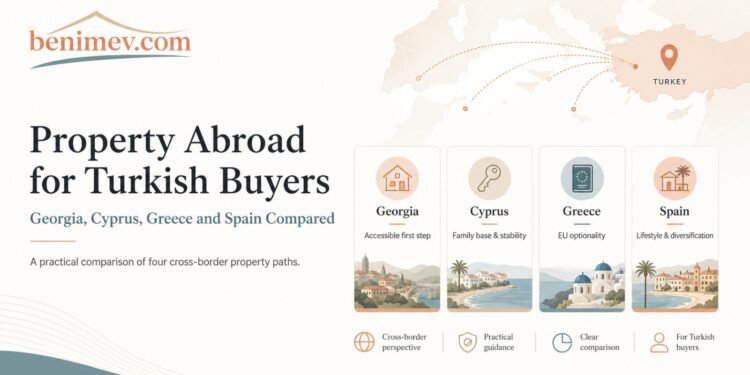
Property Abroad for Turkish Buyers: Explore smart cross-border investment options, residency paths, and stable markets abroad. now
For a long time, people talked about property abroad as if it were one clean, portable idea. You buy somewhere with better weather, a stronger passport environment, maybe a safer legal system, maybe a better long-term hedge against local volatility, and somehow all those motives blend into one tidy category. They do not. That story was always too simple. It is even less true now.
The buyers looking beyond Turkey are not all trying to solve the same problem. Some want a first foothold outside the country without taking on a huge financial burden. Some want a real family base with legal structure and long-term stability. Some want optionality. Some want Europe, though even that word hides more than it reveals. Europe for what, exactly. Lifestyle. Education. Residency. Diversification. A future escape valve. These are not minor distinctions. They change everything, from the market someone should look at to the kind of property that makes sense.
That is why the newer cross-border framing on BenimEv feels more serious than the usual international real estate language. The useful part is not that it mentions several countries. Plenty of sites do that. The useful part is that it treats cross-border buying as a set of different decisions rather than one glossy international dream. That is a much better starting point, because confusion is expensive in property. Once money crosses borders, bad framing is not just annoying. It becomes a risk.
Property in Georgia: Simplicity and First-Step Mobility
Take property in Georgia. Georgia only makes sense when you stop forcing it into the same mental box as EU destinations or Gulf markets. It is not the prestige option. It is not supposed to be. It is closer, simpler, and easier to imagine as a first move for someone who wants something real outside Turkey without immediately stepping into a much larger capital commitment. That changes the buyer profile. The person looking seriously at Georgia is often not chasing status. They are chasing flexibility. They want an accessible second base, or a first international property that feels operational rather than symbolic. That is a very different psychology from someone aiming at a more formal European residency narrative.
Property in Cyprus: Family Stability and Structure
Then there is property in Cyprus, which sits in almost the opposite emotional category. Cyprus is not the cheap option and not the fantasy option either. It tends to appeal to buyers who think in family terms, not just transactional terms. They care about legal clarity, everyday livability, language, proximity to Turkey, education, routine. It feels less like a speculative leap and more like a structured decision. That difference matters. A person considering Cyprus is often not asking, “What is the hottest overseas market right now?” They are asking something slower and more serious. “Where could this actually work for us?” That question produces very different behavior, and very different demand.
Property in Greece: Europe, Optionality, and Long-Term Thinking
Property in Greece still carries a kind of emotional pull that is hard to ignore. Europe does that to people. Greece adds islands, Mediterranean familiarity, the Schengen imagination, the feeling that the asset is not just real estate but also a wider horizon. Still, that old easy narrative has mostly died. Greece is not some universal answer for everyone who wants an EU-linked property story. The people who approach it seriously now tend to be thinking in terms of long-range optionality, portfolio diversification, family mobility, and legal structure. That makes Greece attractive, yes, though not in the frictionless way too many old articles used to suggest. The real value is no longer in selling the fantasy. It is in explaining the conditions clearly enough that the buyer knows what game they are actually entering.
Property in Spain: A Rewritten Narrative
Property in Spain is useful for a different reason. Spain shows how quickly the story around a country can drift away from reality while the marketing language keeps repeating itself online. For years, Spain sat in the minds of many buyers as one of the classic property-plus-residency destinations. That version of the story no longer holds in the same way. Spain still matters, obviously. It matters for lifestyle, for long-term diversification, for relocation planning, for people who simply want exposure to Spanish property because they believe in the country and want to spend time there. What changed is that the old shortcut narrative is gone. That matters because it exposes a deeper problem in this market. Too much international property content is written as if every country still means what it meant three years ago. It does not.
Why Simplified International Property Thinking No Longer Works
That is where a more selective model starts to make sense. Not bigger. Better filtered. The real value in cross-border property is not endless inventory. It is interpretation. Buyers do not just need listings. They need someone to separate one logic from another. Georgia is not a cheaper Greece. Cyprus is not a smaller Spain in Business law terms. Greece is not a universal EU answer. Spain is not the same story it once was. Once you say these things plainly, the whole category gets less glamorous and more useful. Good. It should.
Different Buyers, Different Logic
There is also a supply-side implication here that gets ignored too often. Turkish sellers, agencies, and developers like to talk about “foreign buyers” as if that were one coherent audience. It is not. The buyer comparing Georgia and Cyprus is not the same as the buyer comparing Greek property with Turkish coastal property. One person is optimizing for threshold and simplicity. Another is optimizing for legal structure and long-term family planning. Another is drawn by Europe as a strategic anchor. So cross-border demand is not just more demand. It is segmented demand. If the demand is segmented, the property story has to be segmented too.
From Abundance to Interpretation
That sounds obvious once said clearly, but much of the industry still behaves as if international traffic were one big undifferentiated pile.
The older portal model was built around abundance. Put enough listings on a screen and let people browse until something catches. That can still work in domestic markets where the buyer already understands the rules, the neighborhoods, the financing logic, the basic legal terrain. Cross-border property is different. Distance adds uncertainty. Legal differences add uncertainty. Language adds uncertainty. So the platform that ends up being most useful may not be the one that looks biggest. It may be the one that is most disciplined about what it is and what it is not.
That is probably the strongest part of the current cross-border positioning. It does not need to sound like a giant global marketplace to be useful. In fact, it is better if it does not. A platform becomes more credible when it says, in effect, these are selected markets, these are different buyer problems, and these opportunities should not be flattened into one lazy international narrative. That is not flashy copy. It is more valuable than flashy copy. In property, trust usually begins when someone resists the urge to oversimplify.
Key Takings
So the more interesting question is no longer whether Turkish buyers will continue looking outside Turkey. They will. The more interesting question is whether the platforms serving them can describe those markets honestly enough to be worth listening to. That means fewer recycled templates, fewer vague promises, fewer country pages that all sound the same. It means sharper distinctions, clearer buyer profiles, and a little more willingness to admit that cross-border property is not one story anymore. It is several stories at once, some practical, some expensive, some legally structured, some more aspirational than they first appear. That may be a less glamorous way to talk about the market. It is also much closer to the truth.