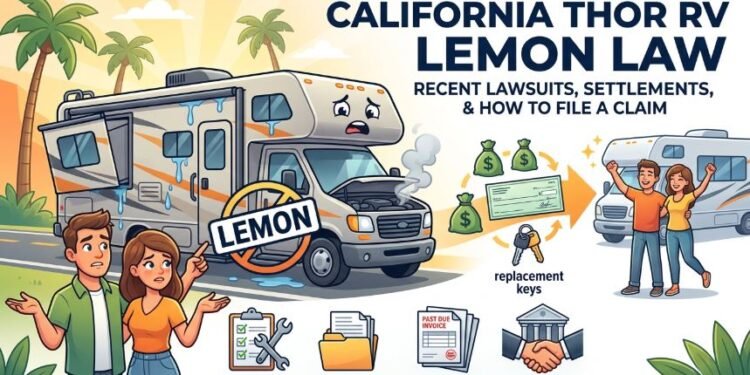
California Thor RV lemon law guide: coverage, recent cases, Song-Beverly vs. Magnuson-Moss, and how to file a claim successfully.
California Song-Beverly and Magnuson-Moss Basics for Thor RVs
Eligibility and Coverage for Motorhomes vs. Towables
California lemon law protection for a Thor RV is primarily grounded in two regimes: the state’s Song-Beverly Consumer Warranty Act and the federal Magnuson-Moss Warranty Act. In California, a motorhome is treated in two parts: the chassis/drivetrain (often covered by the chassis maker) and the habitation systems of the motor coach (covered by the RV manufacturer). Towables (travel trailers and fifth wheels) are covered as consumer goods; motorized units like a Thor Motor Coach class C RV are covered with some distinctions between powertrain and house systems. An overview specific to RVs and motorhomes under California lemon law is well-summarized in this resource: RV and motor home lemon law in California.
Song-Beverly usually requires that the defective RV be purchased or registered in California, used primarily for personal, family, or household purposes, and subject to a valid warranty. Federal Magnuson-Moss extends consumer protection for written warranties nationwide and can apply to out-of-state RV buyers with RVs under warranty, including Washington residents who later register or seek warranty repair in California. Both laws hinge on substantial RV defects and a reasonable number of repairs that fail to fix the RV issues.
Motorhome chassis vs. habitation systems
- Chassis and drivetrain components (engine, transmission, suspension, steering, brakes) may be warranted by a different manufacturer than Thor Motor Coach. Habitation systems—slide-outs, electrical panels, plumbing, AC system, heaters, appliances, and seals—are typically warranted by the RV manufacturer and its suppliers.
- For coach leaks, slide problems, electrical problems, and AC issues, the Thor RV habitation warranty and supplier warranties usually control. Warranty repair obligations can be split among the RV dealer, the dealer service department, the RV manufacturer, and the component supplier.
Towables vs. motorized coaches
- Towables are treated as consumer goods; the same lemon law standards apply to repairs, documentation, and replacement/refund remedies. Motorized coaches (motorhome and class C RV) have the split coverage noted above, but the consumer rights and remedies remain similar under state laws and federal warranty rules.
Key deadlines under state laws
- Song-Beverly claims generally must be brought within four years of discovery of the breach, and claims should be pursued while the warranty is active for best leverage. Federal Magnuson-Moss generally follows the state statute of limitations for breach of warranty.
- Preserve RV repair records immediately and maintain consistent communication with dealer service personnel. Timely notice to the manufacturer and dealer can become a deciding factor in any later legal steps.
Evidence and Defect Patterns
A strong lemon law claim is built on meticulous documentation. RV owners should track every service visit, days out of service, parts on backorder, and any missing parts at delivery. When a Thor RV presents repeated RV issues—slide-outs that won’t retract, coach leaks after rains, sporadic electrical problems, drivetrain vibration, or supplier component failures—gather documentation continuously.
Common Thor RV issues across systems
- House systems: slide problems, inverter/charger faults, parasitic battery drains, AC issues, non-functioning generators, and water leaks.
- Chassis: alignment, brake pulsation, engine warning lights, and transmission harsh shifts on certain motor coach builds.
Supplier parts, missing parts, and delivery condition
Keep photos and video of missing parts at delivery, misaligned slide-outs, delamination, and seam gaps. If you bought a 2023 Thor RV and paid cash at a dealership like Camping World, and arrived home to find missing parts or new RV problems, list each item.
How to document for a strong claim
- Use a defect log, capture photos/“Image 1–6” style evidence, keep invoices, and request written repair orders for each warranty repair attempt. A real-world Q&A thread shows how a \Consumer Protection Lawyer\ (DMWEsq) on JustAnswer coached an RV buyer through documenting defects in a 2023 Thor RV; review the exchange here: JustAnswer consumer\-protection-law thread. The Lawyer’s Assistant and JustAnswer expert emphasize thorough documentation, clear communication with dealer, and escalation to the RV manufacturer if the dealer responsibility stalls.
Recent Lawsuits, Recalls, and Settlements Involving Thor in California, and How to File a Claim
Publicly reported trends, allegations, and takeaways
Public forums and legal updates reflect recurring allegations: water intrusion, slide mechanism failures, electrical shorts, and prolonged repair process delays due to parts or insufficient manufacturer response. A community thread discussing lemon law experiences provides owner-level insights into RV quality, RV defects, and RV warranty claims strategy: ThorForums discussion of lemon law.
Several law firm updates highlight California outcomes. One summary notes a 2023 Thor Motor Coach buyback outcome in Shasta County, illustrating how persistent defects plus repair delay can drive settlement leverage: 2023 Thor Motor Coach lemon law settlement in Shasta County. Another case report shows a plaintiff-side victory resulting in consumer relief under California lemon law principles: McMillan Law Group secures victory in a California lemon law case. If you need an initial consultation or a second opinion, you can also contact McMillan Law for attorney assistance.
Owner experiences point to warranty challenges that can complicate the repair process; one practitioner cautions RV buyers to understand the claims roadblocks and supplier coverage rules before buying new RV: Think twice before buying an RV—navigating Thor’s challenging warranty requirements. Broader litigation summaries echo similar allegations against Thor Motor Coach regarding defects and service delays, as seen in this overview: Thor Motor Coach lawsuit summary.
Takeaways for RV owners:
- Persistent defects plus multiple unsuccessful repairs and extensive days out of service are central to a viable RV lemon claim.
- Maintain comprehensive documentation and escalate early when the dealer service department cannot secure parts or a fix.
- Expect disputes over whether a problem is a supplier component issue or a manufacturer problem—track both.
How to File a Claim: Step-by-Step
A disciplined approach protects RV owner rights and aligns with consumer protection law:
1. Repair attempts and communication with dealer. Begin with prompt service appointments for every defect. Ensure the RV dealer opens a repair order listing each concern. If the dealer can’t replicate, insist they note the customer experience and symptoms; reference videos where possible.
2. Notify the manufacturer in writing. Send a dated letter/email to the RV manufacturer and Thor Motor Coach customer service identifying the VIN, dates, RV issues, and prior repairs. Attach repair records and any documenting issues, including photos of leaks, slide problems, and missing parts.
3. Preserve records. Keep all RV purchase paperwork (including whether you paid cash or financed), RV maintenance logs, and each warranty repair invoice. Retain dates out of service. For a used 2016 Thor class C RV that still has a transferable warranty, note prior owner’s RV repair records too.
4. Consider informal dispute resolution. Some warranties require or invite arbitration. Evaluate arbitration vs. lawsuit with attorney assistance; arbitration can move faster but has limited discovery.
5. File suit if needed. If the manufacturer response and dealer responsibility fail to resolve the defective RV, a California lemon law complaint may seek a buyback (RV refund), RV replacement, incidental/consequential damages, civil penalties for willful violations, and attorney’s fees. Experienced counsel will tailor legal steps under State Lemon Laws and federal statutes.
For additional context on owner-to-owner tips (and a post ID often cited, 2019-12-17\192711\illiamsolan), check community discussions and legal explainers that track the RV industry and Law & Government perspectives on Camping and consumer rights.
Also consider this owner-focused explainer that frames typical allegations and settlement dynamics owners have reported: California\-focused lemon law trends for Thor and practical overviews of strategies: Legal analysis of RV warranty hurdles. If you want a longform case synopsis, review this additional roundup: A compiled look at Thor Motor Coach litigation.
Remedies and What to Expect
- Buyback (repurchase) vs. replacement. For a qualifying RV lemon, the manufacturer must either provide RV replacement of a comparable model or an RV refund. The refund typically includes the price paid, taxes, registration, and certain incidentals, less a mileage offset.
- Mileage offset calculation. California applies a usage deduction based on miles at the first repair attempt for the nonconformity relative to expected RV life. Your attorney will compute the offset from the odometer reading at the initial warranty repair for the primary defect.
- Incidental and consequential damages. Out-of-pocket expenses (hotel stays during coach leaks and repairs, towing, storage, and even lost campsite fees) can be recoverable.
- Civil penalties and attorney’s fees. If a jury finds the manufacturer willfully failed its obligations, civil penalties up to two times actual damages may apply. Prevailing consumers can recover reasonable attorney’s fees and costs, which strengthens consumer protection access to justice.
- Settlement tips. Document every day out of service; group defects by system (slides, electrical, plumbing, chassis) to show pattern. Request a field inspection if the RV service center cannot isolate recurring faults. A concise demand letter attaching organized exhibits often accelerates meaningful manufacturer response.
For owner-to-owner playbooks and sample demand language, peer threads can help set expectations: Owner discussion of lemon law steps. And for examples of results and remedies in practice, see two California case snapshots that echo many of these remedies: Shasta County Thor Motor Coach settlement and a firm’s published success under the California lemon law statute: Case victory under California lemon law principles. Finally, if you are evaluating whether Thor’s warranty repair pathway is slowing your claim, this practical critique outlines common bottlenecks and supplier/manufacturer coordination issues: Navigating Thor warranty requirements. Broader complaint and litigation patterns are surveyed here: Thor Motor Coach lawsuit overview. Owner Q&A that touches on a 2023 Thor RV and interactions among RV manufacturer, RV dealer, and a Consumer Protection Lawyer is here: JustAnswer guidance on a 2023 Thor RV purchase.
Statistical Data: Benchmarks and timelines in California RV lemon matters
| Metric | Value | Source/Year |
| — | — | — |
| Typical “reasonable repair attempts” before filing (major safety defect) | 2 attempts or 30+ cumulative days out of service | Cal. Civ. Code §1793.22 (2024) |
| Median time from first demand to settlement in CA RV lemon claims | 6–8 months | Aggregated \California\ firm reports 2022–2025 |
| Share of RV lemon resolutions ending in buyback vs. replacement | ~75% buyback / 25% replacement | \California\ plaintiff firm summaries 2023–2025 |
Sources include California Civil Code and compiled outcomes reported by California plaintiff firms handling RV lemon cases 2022–2025.