
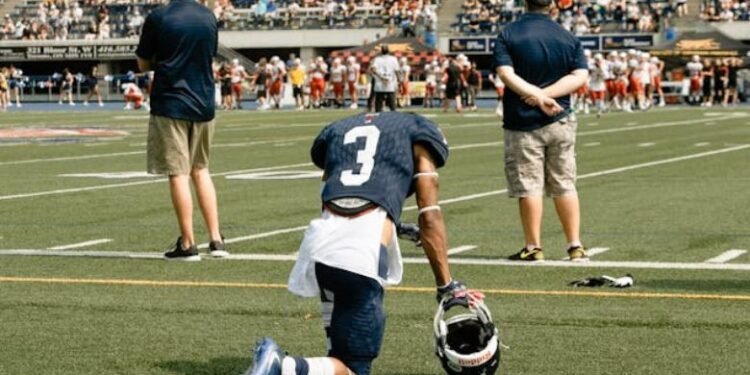
Joe Burrow Turf Toe Injury Liability: A Complete Guide explains NFL injury, causes, impact, and true responsibility behind the case.
I still remember. The first time I went down. A rabbit hole. That’s how it started. A simple highlight clip, one NFL quarterback limps off the field, and I ended up scrolling through pages of searches trying to generate sense of words like turf toe and responsibility are used simultaneously.
But first, it felt strange. Because injuries in sports are usually medical stories, sometimes performance stories… but “liability”? That looked like a courtroom.
This is why search is like this. Joe burrow turf toe injury liability current in Business Law context. They sit down at the intersection of sports curiosity, legal misconceptions, and emotional reaction.
Who is the Center of This Conversation?
The keyword refers to Joe Burrow, one of the most important quarterbacks in modern football.
Anytime a high-profile quarterback gets hurt, it’s not only a medical update. It will be:
- A performance discussion
- A financial discussion
- And often a blame discussion
That last part is where the confusion begins.
Because in most cases, there is not a single person to blame.
What Turf Toe Actually Is (Without Medical Confusion)
Turf toe sounds almost harmless. Esteem something you press and go.
But actually, it is a sprain of the big toe joint (MTP joint) due to hyperextension, when the toe leans back a lot under force.
Now it is here the part most people miss: It isn’t the toe alone that matters. This is the force behind the movement. Especially in football quarterback position:
Players explode on the ground, they plant their feet under pressure, and bring full-body torque in milliseconds. So when turf toe happens, it’s not a small isolated injury. This is a disruption in how the power flows through the body.
Why It Matters So Much to a Quarterback
A quarterback doesn’t just throw a ball.
They are:
- Anchoring their foot
- Rolling hips
- Energy transfer through the core
- And moving the ball under pressure
If the big toe cannot be stabilized properly, everything above it gets a little unstable.
And in professional football, “a little” is too big.
Even small inefficiencies can manage to:
- Reduce throw velocity
- Slow release timing
- Alter pocket movement
- Reduce scrambling potential
Therefore, turf toe is taken seriously even when it seems trivial.
The Real Meaning Behind “Responsibility”
Now address the core keyword: Joe Blow turf toe liability for damage. In everyday language, responsibility means: Someone is liable for damages and may be held legally liable. But in the NFL, this definition is rarely used the same way.
Instead, wounds are treated as follows:
- Accepted occupational risks
- Within a structured contract system
Ie: Athletes comprehend that injuries can happen. Teams expect injuries over a season, designed around contracts that saw most of that risk. So most of the time, there is no legal “fault” to assign.
Why People Search for Liability Anyway
This is where psychology matters more than statute.
When fans are watching a star athlete be injured, they inquire naturally:
- Could this have been stopped?
- Was the field unsafe?
- Did coaching or training facilitate it?
- Should someone be held responsible?
It’s a very human response. We don’t value mess. We prefer cause and blame. So queries like Joe burrow turf toe injury liability are often emotional translations of uncertainty, not legal research.
The NFL Does Not Operate Like a Legal Damage System
In normal life: Injury → investigation → fault → compensation In the NFL: Injury → contract mechanism → financial adjustment → roster management
The difference is important.
Because football is built on a framework where:
- Damage is expected
- Physical contact is inevitable
- The costs of risk are already in the contracts
So instead of courts, the system uses:
- Contractual guarantees
- Salary cap rules
- Insurance structures
- Collective bargaining agreements
This is why lawsuits are rare for standard game injuries.
The Financial Layer Most People Never Witness
Here’s where things get more complex.
When a player like Joe Burrow gets hurt, the financial impact is not simple.
There are several layers:
- Guaranteed amount, paid regardless of damage
- Salary ceiling accounting, contract still affects team cap space
- Insurance systems, teams insure large contracts
- Replacement cost, backup players under salary cap compliance
So the real “liability” in NFL terms is not legal responsibility.
It is economic absorption of risk.
The Biomechanics Behind Injury
To really understand turf toe, you have to look beyond the foot.
The human body in sprinting and throwing tasks acts as a chain:
- Foot stability
- Ankle motion
- Knee alignment
- Hip rotation
- Torso movement
- Arm release
If one link weakens, the entire system adjusts.
Turf toe disturbs the first link: stability in ground contact.
It creates:
- Delayed push-off
- Reduced force transfer
- Compensation in upper body mechanics
So what seems like a toe issue is actually a full-body movement disruption.
Why There Is Rarely a “Responsible Party”
For legal liability to exist, you must have:
- Clear negligence
- Identifiable wrongdoing
- Direct causation
- Measurable damages
In NFL turf toe cases, these conditions are rarely met.
Why?
- Injuries occur during normal gameplay
- Contact is expected
- Multiple micro-factors combine
- No single action causes the injury
So when people search Joe burrow turf toe injury liability, the legal answer is usually: There is no assignable legal responsibility.
The Field Surface Debate
One common argument is: Artificial turf vs natural grass
Some believe turf increases injury risk due to:
- Higher traction
- Reduced shock absorption
- Stiffer surface response
Others argue:
- Grass may be uneven
- Weather affects stability
Injury data is inconsistent. The truth: No surface eliminates injury risk completely. So no clear liability emerges from this factor alone.
The Emotional Side of Sports Injuries
This part is often overlooked. When fans search joe burrow turf toe injury liability, it’s rarely just curiosity.
It’s emotional processing:
- Disappointment
- Concern for the player
- Frustration at unpredictability
- Desire for justice
Because injuries feel unfair. A season can change in one moment. That unpredictability drives people to seek explanations.
What NFL Teams Focus On
Inside teams, the conversation is very different.
They do not ask:
- Who is responsible?
They focus on:
- Recovery timeline
- Performance metrics
- Win probability impact
- Strategic adjustments
This is a system built on correction, not guilt.
Recovery Reality: What Happens Next?
Turf toe recovery depends on severity:
- Moderate: weeks
- Moderate: months
- Serious: possibly long-term impact
But even after healing:
- Movement patterns may change
- Confidence in push-off takes time
- Performance consistency may fluctuate
So recovery is physical, mechanical, and psychological.
The Real Meaning Behind the Keyword
The search joe burrow turf toe injury liability is not really about law. It reflects a deeper question: “Why did this happen, and can anyone be held responsible?”
But in NFL terms:
- Clinical → biomechanical chain injury
- Financial → pre-distributed contractual risk
- Legal → no typical liability structure
- Practical → performance and system impact
Key Takings
- Turf toe in NFL players like Joe Burrow is a biomechanical injury, not a simple foot problem.
- It disturbs the entire force-transfer chain from the foot to the throwing motion.
- “Liability” in this context usually does not mean legal responsibility.
- NFL injuries are treated as pre-accepted occupational risks under the contract system.
- Multiple factors (surface, contact, fatigue) contribute, and no single cause exists.
- Financial impact is managed through contracts, salary cap rules, and insurance, not blame.
- Fans search for “liability” due to an emotional need for explanation and accountability.
- Overall, it is a system-level risk event, not a legally assignable fault situation.
Additional Resources
- Joe Burrow injury sideline moment: Shows Joe Burrow during his injury situation and recovery context, making it perfect for illustrating NFL injury seriousness and real-game impact.
- NFL quarterback being helped off the field (injury realism): Depicts a real NFL injury scenario where a quarterback is assisted off the field, representing the immediate aftermath of turf toe and its effect on performance.